Made pure blood experiment
My Vampire Love (Completed)The Made pure blood experiment is a program designed to manufacture pure-blood vampires, beings who are ordinarily born rather than created. Its decisive significance is that it treats human illness, blood, reproduction, and marriage as instruments of species-level power: Jenifer Kate Lawrence is kept alive by vampire blood while being prepared for an involuntary awakening that could secure the vampires’ position at the top of the supernatural order.
Political Purpose and Species Power
The experiment begins with a struggle for control among supernatural species. Eric Wilson explains that vampires rule because of their pure-blood population, but that power once belonged to the witches and could shift again to witches, shifters, or another species. Because pure-blood vampires are rare, the ruling order seeks to manufacture more of them, not simply to heal individual patients. The experiment therefore joins medical intervention to political preservation: its intended result is a permanent vampire advantage rather than a cure offered for Jenifer’s own sake.
The project also exposes the hierarchy governing the Underworld. Eric’s explanation presents vampire supremacy as an unstable achievement that must be actively defended. If Jenifer awakens as planned, her existence will help ensure that vampires remain dominant. Her body is consequently treated as a strategic resource, and the possibility of producing an even stronger bloodline gives the experiment consequences beyond her personal fate.
Method and Failed Subjects
The first attempts at creating pure-blood vampires failed catastrophically. Humans were given vampire blood in efforts to reproduce a condition that, under ordinary circumstances, could not be made artificially; every earlier subject died or suffered a worse result. The process required precise control of both dosage and frequency. Too much blood given too often produced a made vampire, while too little could cause a coma or create zombies. The experiment thus depends on a narrow threshold between survival, transformation, and bodily collapse.
The researchers then tried to transfer vampire blood to unborn children. They injected fetuses through their mothers or performed blood transfusions during the first three months of pregnancy. These procedures did not produce pure-blood vampires; instead, they resulted in hybrid babies. The failures led to a more targeted theory: if a human could not make blood cells independently, supplied vampire blood might cause that body to produce vampire blood cells and eventually awaken as a true pure-blood vampire.
Jenifer as the Living Subject
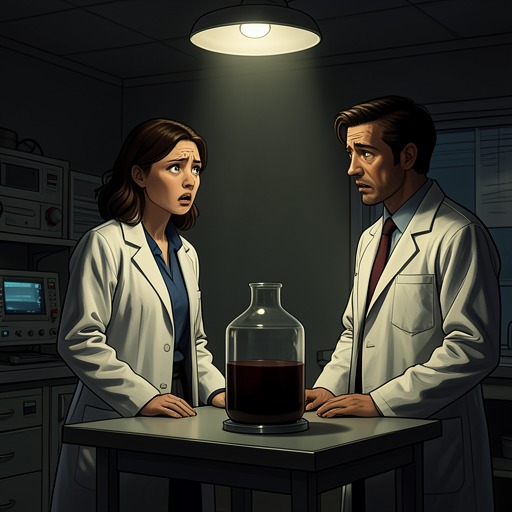
Jenifer’s aplastic anemia makes that theory possible. Her illness prevents her bone marrow from producing red blood cells, white blood cells, or platelets, leaving her vulnerable to infection and potentially fatal bleeding from wounds that would not normally be deadly. The medication she has depended on is not ordinary medicine. Eric reveals that the pills contain his blood in a smaller, weaker form, allowing it to heal her and keep her alive without yet changing her into a vampire.
The treatment therefore has a double function. On the surface, it manages a severe and dangerous disease; beneath that surface, it sustains the experiment by supplying the missing biological material through which Jenifer’s body may eventually generate vampire blood cells. The distinction between patient and test subject collapses. What appears to be care is also a controlled process of transformation, and the very condition that places Jenifer in medical danger makes her valuable to the vampire regime.
Eric identifies Jenifer as the first living human subject capable of becoming a true pure-blood vampire. She is consequently both the most endangered human and the most protected one. Protection does not restore her freedom. It marks her as an exceptional body whose survival is necessary to the experiment, while the prospect of awakening means that her future has already been defined by forces acting through her blood.
Awakening, Marriage, and Reproduction
Pure-blood vampires awaken at eighteen. Before that age, the vampire blood remains dormant and the individual can appear essentially human; at awakening, the blood produces greater strength, speed, and other supernatural capacities. Jenifer learns that she will awaken when she reaches eighteen, whether she wants the transformation or not. Her illness has not merely saved her life through the supplied medication; it has made her the experiment’s successful outcome.
This timetable explains the pressure surrounding her engagement to Eric. He states that he must marry her before she turns eighteen because her awakening will make her a vampire. Marriage is therefore presented not as a private romantic decision but as a condition within a bloodline and succession system. Once awakened, Jenifer will be able to produce a child with Eric, and Eric describes that child as the purest and strongest pure-blood. Her body is valued first as a vessel of transformation and then as a means of reproducing vampire supremacy.
The experiment also produces a direct threat to Jenifer’s life. Eric explains that werewolves want her dead because her awakening could create stronger pure-blood vampires and preserve vampire dominance. The same process that makes her indispensable to the ruling species makes her a target of its enemies. Her protection, surveillance, arranged engagement, and exposure to violence all arise from this contradiction: she must remain alive, but she is not permitted to decide what her survival will mean.
Gothic Institutions and Narrative Consequences
The experiment is embedded in spaces and institutions that make private life feel like inherited property. The Wilson family’s enormous mansion resembles a fairy-tale castle, and its secret archive contains hundreds of bookcases, glass showcases, and a family tree engraved across the walls with millions of names linked by vines. That material record places Jenifer inside a bloodline extending back to Lilith, turning ancestry into an architectural force. The castle’s beauty does not soften the system; it gives domination an impressive, almost enchanted form.
The contrast between appearance and coercion is central to Jenifer’s transformation. She moves from an ordinary life in Trinidad as a seventeen-year-old human girl to a world in which she is a rare pure-blood vampire, engaged to a man she barely knew, and expected to protect his happiness and safety. At the wedding, she sees herself in a carefully made gown as a perfect princess or Barbie-like figure and fails to recognize the person in the mirror. The ceremony makes visible what the experiment has done internally: it has replaced an uncertain human identity with an image designed by family, bloodline, and supernatural expectation.
The ruling order’s laws reinforce this enclosure. Eric invokes vampire law to prevent Katalin from harming him or Jenifer, while Katalin counters that her higher rank and hereditary claim to the throne place her above him. Elsewhere, Dean and his pack are assigned to guard Jenifer from Underworld matters, even though Eric fears that Dean could turn against them. These conflicts show that Jenifer’s safety is administered through competing jurisdictions rather than secured by her consent.
At the engagement gathering, Katalin’s arrival turns the ceremonial space into an openly militarized one. The doors slam, the vampires bow, and Katalin’s blue shield pulses around her like a living weapon before she orders everyone to leave. When the room is sealed with Jenifer, Eric, and their families inside, the protected subject becomes visibly caged. The experiment’s aesthetic of beauty, lineage, and ceremony therefore culminates in confinement: the promise of a stronger future for vampires depends upon enclosing one young woman’s body and future within their system.